
ustaxrecovery.com is an independent document preparation and tax support service, not affiliated with or endorsed by the IRS or any government agency.
U.S. Tax Refund for Canadians on Horse Racing and Pari-Mutuel Winnings: A Complete Guide
If you've ever cashed a winning ticket at Woodbine, Saratoga, or a Kentucky Derby simulcast and watched 30% of it disappear before the teller even hands you cash, you already know the pain. This guide walks through exactly why that happens, what paperwork proves it, and how a U.S. tax refund for Canadians on horse racing and pari-mutuel winnings actually gets processed and paid out.
Horse racing withholding works differently from slot machine or table game withholding, and the refund path has its own quirks — different thresholds, different forms, and a document you may not have realized you needed to keep.
Understanding the 30% U.S. Withholding Tax on Horse Racing Winnings

Under U.S. tax law, nonresident aliens — which includes virtually every Canadian who isn't a U.S. citizen or green card holder — are subject to a flat 30% withholding tax on U.S.-source gambling income, unless a tax treaty reduces or eliminates it. For horse racing and other pari-mutuel wagering (harness racing, greyhound racing, jai alai), that 30% is taken directly off qualifying winnings at the track, off-track betting facility, or advance deposit wagering platform before you ever see the money.
The key number to know is the reporting threshold: for pari-mutuel wagering, a payout typically triggers withholding and IRS reporting when the winnings are $600 or more and at least 300 times the amount of the wager. A $2 exacta ticket that returns $610 clears both tests; a $2 win ticket that pays $650 straight up doesn't hit the 300-to-1 ratio and generally won't be withheld or reported the same way. This is a meaningfully different rule than the flat $1,200 slot machine threshold — worth understanding if you split time between the track and the casino floor (see our breakdown of the slot machine tax threshold for comparison).
Because Canada and the U.S. have a tax treaty, Canadian bettors aren't stuck with that 30% permanently — but you have to actively file to get it back. Nobody mails you a refund automatically.
Why Pari-Mutuel Winnings Get Taxed Differently for Canadian Bettors
Pari-mutuel betting pools all wagers together and pays out from that pool after the track takes its cut — it's structurally different from a slot machine or blackjack hand, where the casino is betting directly against you. That structural difference is exactly why the IRS treats it differently for withholding purposes.
Two things follow from this:
- The 300-to-1 test matters enormously. A big long-shot exacta or trifecta payout is far more likely to trigger withholding than a modest win bet on a favorite, even if the dollar amounts are similar.
- Session-based netting works differently than slots. With pari-mutuel wagering, each winning ticket is generally evaluated on its own, not aggregated across a day at the window the way slot machine jackpots sometimes get bundled. That makes accurate, ticket-by-ticket recordkeeping more important than people expect.
The U.S.-Canada tax treaty (Article XXII) is what allows Canadians to offset gambling winnings with documented gambling losses when filing a U.S. nonresident return — a benefit bettors from many other countries, including the UK and Australia, don't get in the same form. If you want the deeper mechanics of that treaty provision, we've covered it separately in Canada-U.S. Tax Treaty Gambling Losses: What Article XXII(3) Allows.
What Is Form 1042-S and Why You Need It to Claim a Refund
When a track or wagering operator withholds tax from your payout, they're required to report it to the IRS — and to you — on Form 1042-S, “Foreign Person's U.S. Source Income Subject to Withholding.” This is your proof that tax was withheld, how much, and from what type of income.
Form 1042-S is not optional paperwork you can skip. Without it, you have no documented basis for the IRS to verify a refund claim. The form shows:
- The gross amount of the reportable winnings
- The exact amount withheld (usually 30%, listed as tax rate “30.00”)
- The payer's information (the track or wagering platform)
- Your identifying information — which is where an ITIN becomes essential
Tracks are required to issue these by March 15 of the year following your win, similar to the deadline casinos face with the same form. If you won in July and haven't received a 1042-S by the following spring, follow up with the track's finance office — some smaller regional tracks are slow to mail them, and a duplicate can usually be requested. For a broader look at how this form functions across different gambling contexts, see What Is IRS Form 1042-S? A Guide for Canadian Casino Winners.
Do You Qualify? Eligibility Rules for Recovering Withheld Tax
Not every Canadian bettor with withheld winnings is guaranteed a full refund, and the rules aren't as simple as “get it all back.” Broadly, you need:
- Nonresident alien status — you're a Canadian resident, not a U.S. citizen or green card holder, filing as a nonresident for U.S. tax purposes.
- Proof of withholding — your Form 1042-S showing tax was actually withheld on qualifying pari-mutuel income.
- Documented losing wagers (if claiming loss offsets) — under the treaty, you can offset gambling winnings with gambling losses from the same tax year, but only with adequate records: losing tickets, wagering account statements, or a win/loss statement from the track or ADW platform, if one is available.
- A valid ITIN — required to file the nonresident return that actually processes the refund.
The amount you get back depends on your specific tax situation. If your gambling losses for the year equal or exceed your winnings, you may be entitled to a full refund of the withheld tax. If you had a net winning year, you'll likely get back a portion, since actual U.S. tax liability on net gambling income is often lower than the flat 30% withheld — but you'll still owe something. This is why “you can always get 100% back” is a myth worth retiring; the honest answer is “it depends on your losses and your total filing picture.”
Not sure where to start? We'll walk you through it.
Getting an ITIN: The Missing Piece for Most Canadian Claimants
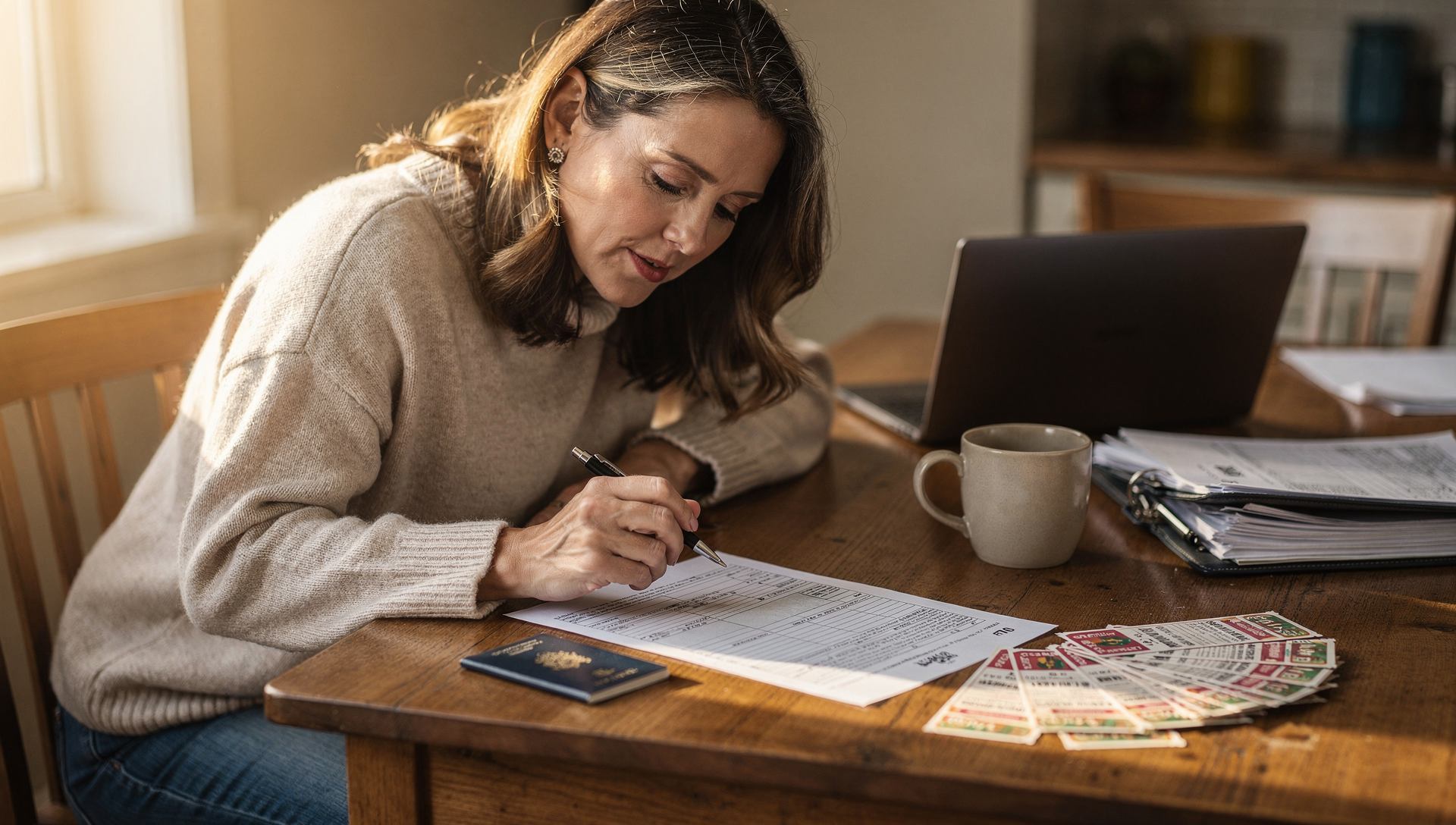
Here's where most claims stall before they even start. To file the nonresident tax return (Form 1040-NR) that triggers your refund, you need a U.S. Individual Taxpayer Identification Number — an ITIN. Most Canadian recreational bettors don't have one, because you only need it in situations exactly like this one.
The IRS is the only body that issues an ITIN — it happens through Form W-7, submitted with certified proof of identity (usually a certified copy of your passport) and, in this case, your 1042-S as proof of the tax withholding that justifies the application. Firms like U.S. Tax Recovery aren't part of the IRS and can't issue an ITIN ourselves; what we do is act as a Certified Acceptance Agent-supported intermediary, preparing the W-7 correctly and verifying your documents so the application isn't rejected on a technicality — which is one of the single biggest causes of refund delay. For the full rundown on why this number matters and how it's obtained, see What Is an ITIN and Why Do Canadian Casino Winners Need One?
If you already have an ITIN from a prior casino or poker win, check whether it's still active — ITINs expire after three consecutive years of non-use on a filed return, and an expired number has to be renewed before it can be used again. We've written about that process in detail in Expired ITIN? How Canadians Renew Before Filing a Casino Refund.
Step-by-Step: How the IRS Refund Claim Process Actually Works
| Step | What Happens | Typical Timing |
|---|---|---|
| 1. Gather documentation | Collect Form 1042-S, losing tickets/wagering records, passport copy | Before filing |
| 2. IRS Identity Documentation (Form W-7, if needed) | Submit Form W-7 with certified ID and 1042-S | 7–11 weeks for IRS processing |
| 3. Prepare Form 1040-NR | Report gross winnings, claim treaty-allowed loss offsets | Filed with or after ITIN approval |
| 4. Submit to IRS | Return filed by mail (nonresident returns generally can't be e-filed the same way as domestic ones) | — |
| 5. IRS review | IRS verifies withholding against the 1042-S on file and processes the return | Varies by season |
| 6. Refund issued | Check or direct deposit to your account | Weeks to several months after filing |
The order matters: if you need an ITIN, that has to be resolved (or filed simultaneously with your first return, which the IRS allows) before the refund can move. Filing a return with a placeholder or incorrect identifying number is one of the fastest ways to get a claim rejected outright.
How Long It Takes to Get Your Refund and What Can Slow It Down
For a straightforward claim with an existing valid ITIN, refunds often arrive within roughly 3 to 5 months of filing. If you need a new ITIN alongside your first return, add the 7-to-11-week ITIN processing window on top, since the IRS's ITIN unit reviews the W-7 before your return proceeds through normal channels. Realistically, first-time claimants should expect somewhere in the range of 4 to 8 months from submission to refund, and it can run longer during the IRS's peak spring filing season (roughly February through April), when nonresident return volume competes with the much larger domestic filing rush.
Common slowdowns include incomplete W-7 documentation, a 1042-S that doesn't match IRS records exactly (a transposed digit or mismatched payer TIN can trigger manual review), and mailing a return to the wrong IRS service center. We go into the seasonal and procedural factors in more depth in How Long Does a U.S. Gambling Tax Refund Take for Canadians.
Common Mistakes That Cause Delays or Denied Horse Racing Tax Refunds
- Losing or never requesting the 1042-S. Without it, there's no verifiable record of withholding to refund.
- Assuming all winnings were reported. Small payouts under the 300-to-1 and $600 thresholds often weren't withheld or reported at all, so there's nothing to reclaim on those.
- Weak loss documentation. A shoebox of losing tickets with no dates or wager amounts noted is much harder for the IRS to accept than an organized log or an ADW platform's official statement.
- Letting an ITIN expire between claims. Bettors who file once, then don't file again for a few years, often find their old ITIN no longer works.
- Mismatched names or SSN/ITIN fields between the 1042-S and the W-7/1040-NR — a simple clerical error that routinely stalls processing for months.
- Missing the filing deadline. Refund claims generally need to be filed within three years of the tax year in question; wait too long and the window closes. See How Far Back Canadians Can Claim U.S. Casino Tax Refunds for specifics.
Not sure where to start? We'll walk you through it.
How U.S. Tax Recovery Handles the Paperwork So You Get Paid Faster
Recovering withheld horse racing tax involves the same core mechanics as any casino tax recovery — a 1042-S review, an ITIN determination, and a properly filed 1040-NR — but pari-mutuel claims come with their own wrinkles around the 300-to-1 threshold and ticket-level documentation that general casino guidance doesn't cover. We review your 1042-S and betting records up front to confirm you actually qualify before any paperwork goes to the IRS, prepare the W-7 with the right supporting documents so it isn't kicked back for something fixable, and file the 1040-NR with your treaty-eligible loss offsets calculated correctly rather than left on the table.
Our fee structure is contingency-based: there's no upfront cost, and we only get paid once your refund is actually issued. If you're sitting on a 1042-S from a Woodbine trifecta, a Saratoga daily double, or an ADW platform payout and haven't filed, it's worth finding out what you're actually owed before that three-year window closes.
Related guides
- IRS Form 5754: How Canadians Splitting a Casino Jackpot Should Report Winnings for a Refund — this might help you too
- State Tax Withholding on Casino Winnings: Why Canadians May Owe More Than Just the IRS 30% — this might help you too
- Poker Tournament Winnings Tax: What Canadians Owe in the U.S. — this might help you too
Frequently Asked Questions
How much U.S. tax is withheld on horse racing winnings for Canadians?
The IRS withholds 30% on qualifying pari-mutuel winnings that meet both the $600 payout and 300-to-1 wager ratio thresholds, unless a treaty reduction applies at the time of payout.
What is Form 1042-S and why do I need it for a horse racing tax refund?
Form 1042-S is issued by the track or wagering platform to document the amount withheld from your winnings. It's required proof for the IRS to process any refund claim.
Do I need an ITIN to claim back withheld horse racing tax?
Yes. Filing the nonresident return (Form 1040-NR) needed to claim a refund requires a valid ITIN, which is applied for using Form W-7 along with certified ID and your 1042-S.
Can Canadians offset horse racing winnings with gambling losses?
Yes, under Article XXII of the U.S.-Canada tax treaty, Canadians can offset documented gambling losses against winnings when filing a U.S. nonresident tax return.
How long does it take to get a horse racing tax refund from the IRS?
With an existing valid ITIN, refunds typically take 3 to 5 months. First-time claimants needing a new ITIN should expect 4 to 8 months from filing to refund.